
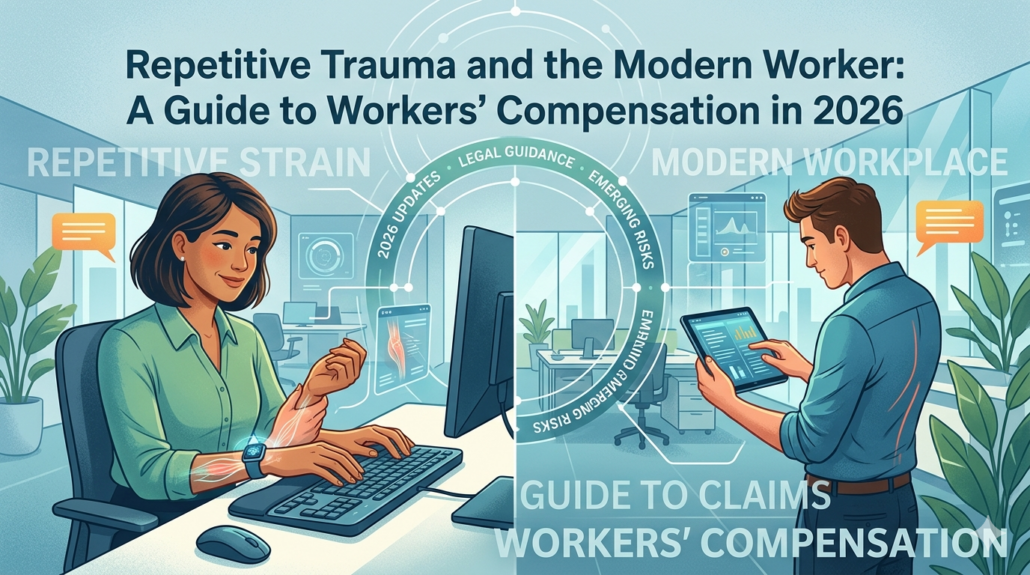
Repetitive Trauma and the Modern Worker: A Connecticut Guide to Workers’ Compensation in 2026
For many, the phrase “workplace injury” conjures images of sudden, dramatic accidents—a fall from a ladder, a construction site mishap, or a slip in a warehouse. While these acute injuries are common, they represent only one facet of the risks facing the modern workforce. In 2026, as our economy increasingly relies on high-speed automation, prolonged digital interface, and intensive manual logistics, a more subtle threat has taken center stage: Repetitive Trauma Injuries.
Workers’ Compensation benefits are not limited to those injured in single, identifiable accidents. Benefits are also available to employees who suffer from the cumulative impact of repetitive activities on the body over months or years. Known legally as “cumulative trauma” or “repetitive strain,” these conditions are often more complex to prove but just as debilitating as any sudden fracture.
The Evolution of Repetitive Trauma in 2026
As we move further into the mid-2020s, the definition of repetitive trauma has expanded. We no longer just look at the assembly line worker or the typist. Today’s repetitive trauma claims often involve:
- Remote Work “Tech Neck” and Postural Strain: With a significant portion of the workforce still operating from home offices that often lack professional ergonomic oversight, we have seen a surge in cervical spine issues and upper-back degenerative conditions.
- Logistics and Fulfillment Fatigue: The “delivery economy” has peaked. Workers in massive automated fulfillment centers are often required to perform high-frequency movements—reaching, pivoting, and scanning—thousands of times per shift, leading to rapid joint degradation.
- Haptic Interface Strain: In specialized fields using VR/AR interfaces or haptic gloves (common in remote surgery, advanced manufacturing, and engineering), new forms of micro-repetitive strain in the fingers and wrists have emerged.
Common Types of Repetitive Trauma Injuries
While the list of potential injuries is vast, several conditions remain the “hallmarks” of cumulative trauma claims.
- Carpal Tunnel Syndrome and Nerve Compression
Perhaps the most famous repetitive injury, Carpal Tunnel Syndrome (CTS), involves the compression of the median nerve in the wrist. In 2026, this is not just an “office worker” disease; it is prevalent among dental hygienists, garment workers, and those in the tech sector who utilize gesture-based controls. Symptoms often begin as a faint tingling or numbness in the thumb and index finger, eventually progressing to a loss of grip strength that can end a career.
- Occupational Hearing Loss
Often overlooked because it happens gradually, hearing loss from loud work environments is a classic repetitive trauma. Despite advancements in “smart” noise-canceling PPE, workers in aviation, manufacturing, and even high-decibel entertainment venues remain at risk. In many jurisdictions, the “cumulative” nature of hearing loss requires sophisticated audiometric testing to prove the loss occurred during the period of employment.
- Rotator Cuff and Shoulder Impingement
Frequent overhead work—common for electricians, painters, and HVAC technicians—causes micro-tears in the tendons of the shoulder. Over time, these tears fail to heal, leading to chronic inflammation or full-thickness tears. By 2026, medical imaging (such as high-resolution dynamic ultrasound) will have made it easier to show how specific repetitive motions have “frayed” the tendon over time.
- Degenerative Disc Disease and Spinal Trauma
Frequent heavy lifting, twisting, and bending are the primary culprits for back injuries. Unlike a “herniated disc” caused by lifting one heavy box, degenerative back conditions involve the gradual wearing away of the cushioning between vertebrae. In the modern legal landscape, employers often try to blame these conditions on “aging” or “pre-existing wear and tear.” However, if work activities accelerated the condition, it is a compensable injury.
- Epicondylitis (Tennis/Golfer’s Elbow)
Inflammation of the tendons surrounding the elbow is common in jobs involving repetitive gripping or tool usage, such as plumbing, carpentry, and even intensive data entry.
The Legal Threshold: Proving the Link
The greatest challenge in a repetitive trauma claim is the “Causation Barrier.” Unlike a broken leg, where the cause is obvious, a repetitive injury requires medical evidence to link the condition directly to the job duties.
In 2026, courts and Workers’ Compensation boards typically look for “Gradual Onset” and “Specific Work Exposure.” To successfully bring a claim, the evidence must show that:
- The work required repetitive motions, vibrations, or pressures.
- The frequency and duration of these activities were sufficient to cause the injury.
- The injury is not solely the result of non-work-related activities or natural aging.
Modern litigation often involves “Ergonomic Experts” who analyze a worker’s daily routine, counting repetitions and measuring force, to provide a scientific basis for the claim.
Statutes of Limitations: The 2026 Landscape
Timing is everything. In many states and jurisdictions, the “clock” for filing a claim starts at different times for repetitive trauma than it does for an accident. As noted in the current legal framework:
- The Last Date of Exposure: A worker must often file within one year of the last date they performed the repetitive work.
- The Discovery Rule: Alternatively, a claim can often be filed within three years from the date the worker first experienced symptoms and knew (or should have known) that the symptoms were caused by their work.
Warning: Waiting until you can no longer work at all is a common mistake. By the time the pain is unbearable, you may have passed the statutory deadline. Early reporting is essential.
Challenges in the 2026 Claims Process
The landscape for Workers’ Comp has become more rigorous. Insurance carriers now utilize AI-driven “Claims Adjusters” to scan medical records for any mention of outside hobbies (like gardening, gaming, or sports) to argue that the injury occurred outside of work.
Furthermore, the rise of the “Gig Economy” has complicated these claims. If you are classified as an independent contractor rather than an employee, you may be initially denied benefits. However, “Misclassification Suits” are at an all-time high in 2026, and many “contractors” are successfully arguing they are legally employees entitled to repetitive trauma coverage.
Steps to Take if You Suspect an Injury
If you believe your chronic pain or loss of function is work-related, you should follow these steps immediately:
- Report the Symptoms to Your Employer: Even if you don’t have a “diagnosis” yet, notify your supervisor in writing that you are experiencing pain you believe is related to your repetitive tasks.
- Seek a Specialized Medical Opinion: General practitioners may miss the occupational link. See an occupational therapist or an orthopedic specialist who understands workplace ergonomics.
- Document Your Daily Routine: Keep a log of how many times a day you perform a specific action (e.g., “I lift 20lb bins approximately 400 times per shift”).
- Consult a Workers’ Compensation Attorney: Because repetitive trauma claims are frequently contested by insurance companies, having a legal expert to navigate the “medical-legal” interface is vital.
You Deserve Protection
The body is not a machine; it has limits. Whether you are a software engineer with debilitating wrist pain, a warehouse associate with a failing back, or a nurse with shoulder strain from patient transfers, the law recognizes your right to a healthy body.
Workers’ Compensation is a system designed to provide medical care and wage replacement while you recover. Do not let the gradual nature of your injury convince you that it is “not a real injury.” In 2026, the cumulative impact of work is more recognized than ever.
If you or a family member is suffering from a chronic injury caused by a period of repetitive work activity, please do not hesitate to contact a Workers’ Compensation attorney. Determining your eligibility early can mean the difference between a successful recovery and a lifetime of chronic pain.



Leave a Reply
Want to join the discussion?Feel free to contribute!