
Who Has the Right of Way in a Connecticut Crosswalk? CGS 14-300 Explained
Inside a crosswalk, the pedestrian usually goes first. Outside one, the car usually does. That two-line summary of the Connecticut crosswalk right of way holds up as far as it goes, yet it skips the details that tend to decide real injury claims, and it says nothing about the care each side still owes the other.
Those details reach well past traffic court. An insurance company handling a pedestrian claim studies the same statutes, hunting for any gap between what the person on foot did and what the law asked of them. That review can begin within hours of a crash, often with a polite request for a recorded statement. Meanwhile, the person who was hit is usually the last to find out which rules applied.
What Does Connecticut’s Crosswalk Statute Require of Drivers?
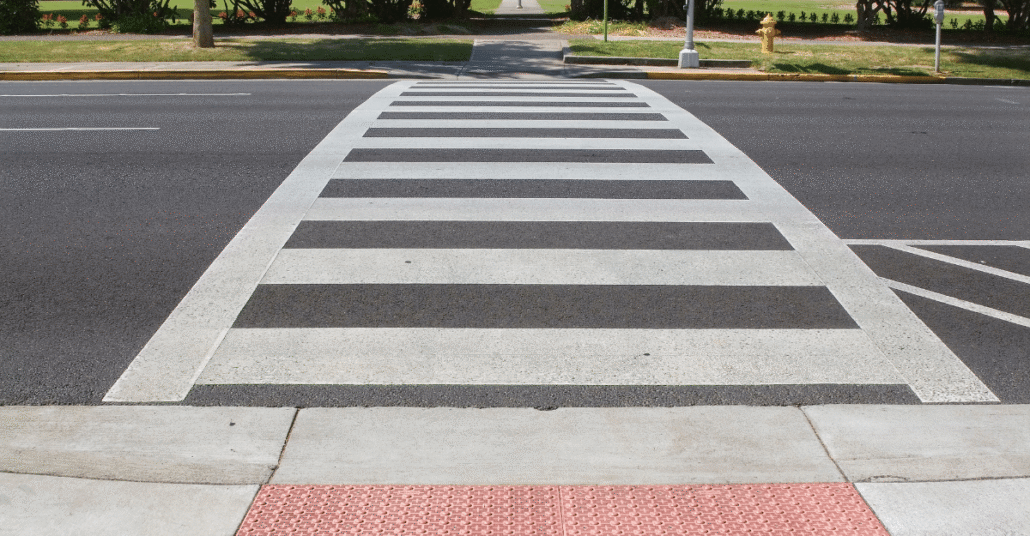
Under Conn. Gen. Stat. § 14-300(c), a driver must slow or stop and yield to any pedestrian crossing within a marked or unmarked crosswalk that no traffic signal or police officer controls. The duty applies whenever the pedestrian is within any portion of the crosswalk, not only the half of the road nearest the driver.
Notice the verb. Connecticut’s pedestrian right-of-way law talks about granting the right of way, which is a bigger ask than simply not hitting someone. Nobody expects a driver to brake for a person still strolling toward a corner half a block away. Once that person qualifies as crossing, though, the driver has to adjust early enough that the walker never needs to stop short, rush, or dodge.
These crossings are everywhere. Mid-block crosswalks near shopping plazas, intersections with no lights, striped lines outside parks and schools: at each one, a driver’s only instruction is the paint on the road and the person standing beside it. A short drive along Route 10 in Cheshire passes plenty of them, tucked between side streets and commercial entrances.
Does the Rule Cover Unmarked Crosswalks?
Yes. Connecticut’s yielding duty reaches unmarked crosswalks as well as painted ones. Under Conn. Gen. Stat. § 14-297, a crosswalk includes the area at an intersection where the sidewalk lines would extend across the road, so a pedestrian crossing at a corner with no stripes can still hold the right of way.
No paint, no crosswalk? Plenty of drivers think so. On quiet residential corners in Cheshire and Hamden, that belief causes collisions, because the state’s legal definition of a crosswalk recognizes an invisible crossing wherever sidewalks meet at an intersection.
Paint still counts for something. Any crosswalk a traffic authority designated on or after October 1, 2010, must carry whatever markings, signs, or signals that authority considers necessary to give pedestrians enough time to get across safely. Faded stripes or missing signs at a designated school crossing, such as the streets around Cheshire Academy, can become evidence in an injury claim.
How Often Are Pedestrians Hurt on Connecticut Roads?
Connecticut’s Highway Safety Office counted 1,474 crashes involving people walking and biking in 2023, causing 180 serious injuries and 64 deaths. Preliminary 2025 figures from CTDOT show overall traffic deaths fell 12 percent from 2024, while pedestrian deaths ran 6 percent above the five-year average.
Bicyclists are counted alongside walkers in the state’s pedestrian safety program data, so the totals capture everyone on the road without a vehicle around them. That same office funds Watch for Me CT, an awareness campaign run through Connecticut Children’s Injury Prevention Center and aimed at drivers and walkers alike.
What stands out is the split. CTDOT’s review of 2025 traffic deaths welcomed the overall drop while calling pedestrian fatalities a continuing concern. Fall tends to sharpen the risk, as the evening commute slides into darkness and drivers heading home past downtown New Haven and the Yale campus meet people crossing in poor light. Many of the region’s most serious pedestrian injuries end up at Yale New Haven Hospital, a Level I trauma center.
What Counts as Entering a Crosswalk Under Connecticut’s 2021 Pedestrian Safety Law?
Since October 1, 2021, a pedestrian counts as crossing when standing anywhere in the crosswalk, when waiting at the curb and raising a hand and arm toward oncoming traffic, or when moving any part of the body, or an extension of it, into the crosswalk entrance.
The old rule was harsher. Before Public Act 21-28, a driver’s duty began only after a pedestrian stepped off the curb, which meant putting a foot into moving traffic just to claim a turn. Today a person can signal from the safety of the sidewalk.
The law also lists what counts as an extension of the body. Placing or pushing any of these into the crosswalk entrance triggers the driver’s duty:
- Mobility aids: a wheelchair, cane, walking stick, or crutch
- Wheeled items: a stroller, carriage, or cart
- Bikes: a bicycle or electric bicycle
- Pets: a dog on a leash or in a harness
Proving the signal is a different matter. Claims often hinge on whether the driver had a fair chance to see it, and surveillance footage from nearby businesses, dashcam video, or a witness waiting at the same corner can show a raised hand or a stroller wheel at the curb’s edge well before impact.
Who Goes First When a Walk Signal Controls the Intersection?
At intersections with pedestrian signals, people on foot must cross only as the signal directs. A pedestrian who has already started across keeps the right of way over every vehicle, including drivers turning right or left, until reaching the opposite curb or a safety island.
Turning drivers are the usual problem. Someone making a right on green, or a left across oncoming lanes, is searching for a gap in traffic and tends to glance at the crosswalk last. Once the walker is in motion, the law resolves that conflict in the walker’s favor. Then there’s the countdown. Stepping off after the hand starts flashing can weaken a pedestrian’s position. A person who left the curb on the walk symbol and is still mid-street when the timer hits zero, however, keeps priority all the way to the far side.
Some intersections have ordinary traffic lights and no pedestrian signals at all, and sometimes an officer is directing traffic instead. In either case, pedestrians may not cross against a red or “Stop” indication. Whitney Avenue in Hamden, near Quinnipiac University, packs all of these setups into a few blocks.
Is It Legal to Pass a Car That Has Stopped for a Pedestrian?
No. Connecticut law bars a driver approaching from behind from overtaking and passing a vehicle that has stopped to let a pedestrian cross. The rule matters most on multi-lane roads, where a stopped car in one lane can block the view of a walker crossing into the next lane.
The pattern is well known enough that traffic engineers have a name for it: the multiple-threat crash. One driver stops, maybe with a wave. The pedestrian steps out. A second driver in the next lane, blind to what is happening beyond the stopped car, figures it is turning or stalled and keeps rolling.
Speed makes these crashes worse than most turning collisions, since the passing driver never sees a reason to slow down. West Main Street in Meriden, with its multiple lanes and constant stops for buses, deliveries, and turns, shows exactly the sight-line trap this rule is meant to close.
What Extra Duties Do Drivers Owe Blind Pedestrians?
Drivers in Connecticut must slow down or stop for any blind pedestrian carrying a white cane, or a white cane tipped in red, or walking with a guide dog. The same law reserves white canes for blind people, so the cane tells drivers that the person cannot see approaching traffic.
Here the duty follows the person, not the paint. A blind pedestrian with a cane or guide dog is owed extra caution wherever they meet traffic, including at corners where the crosswalk lines wore away years ago. “I didn’t see the cane” rarely holds up well. A white cane is a legally protected signal, and a careful driver is expected to recognize it. So is a guide dog in a harness.
When Must a Pedestrian Yield to Traffic in Connecticut?
Under Conn. Gen. Stat. §§ 14-300b and 14-300c, pedestrians must yield to vehicles when crossing outside a marked or unmarked crosswalk, and they may not step suddenly off a curb into a vehicle’s path. People impaired by alcohol or drugs to the point of being a hazard may not walk or stand in the roadway.
Jaywalking is not a crime here, whether it happens in downtown Waterbury or on a country road. A violation of the pedestrian crossing rules is an infraction, the same category as many minor traffic tickets. Those rules also require the walker to give way in a few more situations:
- Diagonal crossings: crossing an intersection corner to corner is off-limits unless a signal or police officer authorizes it
- Between signals: between two adjacent intersections with traffic signals, pedestrians may cross only within a marked crosswalk
- Lane position: inside a crosswalk, walkers should keep to the right half when practicable
Walking along a road has its own rules. A usable sidewalk is the place to be. Without one, the state’s road-use rules for pedestrians send people to the shoulder, and on a two-way road with no shoulder, to the left edge, facing oncoming traffic.
Do Drivers Owe Any Duty to Pedestrians Outside a Crosswalk?
Yes. Under Conn. Gen. Stat. § 14-300d, drivers must use due care to avoid striking any pedestrian and must give warning with a horn or another lawful device when needed, even when the person is crossing mid-block or against the signal. Losing the right of way never gives a driver permission to hit someone.
No town ordinance can undo this. The driver due-care law applies notwithstanding any other statute or local rule to the contrary. Picture someone stepping out between parked cars on North Colony Road in Wallingford: the approaching driver still has to brake or warn, whoever technically had priority.
That is why so many jaywalking claims survive. A pedestrian who crossed in the wrong spot may share some fault, but a driver who was speeding, texting, or just not looking may carry more of it. In a mid-block crash, a jury usually weighs:
- Speed: whether the driver could have stopped at a lawful, reasonable speed
- Sight distance: how long the pedestrian was visible before impact
- Lighting: streetlights, headlights, and the pedestrian’s clothing
- Driver attention: phone use, passengers, or other distractions in the seconds before the crash
What Penalties Can a Driver Face for Failing to Yield?
Violating Connecticut’s crosswalk statute can cost a driver a fine of up to $500. Under Conn. Gen. Stat. § 14-300i, a separate fine of up to $1,000 applies when a driver’s failure to use reasonable care causes substantial bodily harm, serious physical injury, or death to a pedestrian who was using reasonable care.
People usually call that second law the vulnerable user statute. Pedestrians are just one group it protects. The vulnerable user law also reaches:
- Highway workers and people riding or driving an animal
- Riders of bicycles, electric bicycles, electric foot scooters, skateboards, roller skates, and in-line skates
- Wheelchair users and blind people traveling with service animals
- Operators of certain vehicles, including garbage and recycling trucks, mail vehicles, and express delivery vehicles
None of that money reaches the injured person. Fines go to the state, so a pedestrian healing from a fracture at MidState Medical Center in Meriden gets nothing from the driver’s ticket. Medical bills, lost income, and pain and suffering in a Connecticut injury case come only through an insurance claim or a civil lawsuit.
Does a Failure-to-Yield Ticket Prove Fault in a Pedestrian Injury Claim?
Not automatically. Subsection (g) of Connecticut’s crosswalk statute says negligence per se does not apply in civil cases arising under the yielding and blind-pedestrian rules or the related pedestrian statutes. The injured pedestrian must still prove the driver failed to act as a reasonably careful driver would under the circumstances.
That surprises people. In many injury cases, breaking a safety statute counts as negligence on its own, a doctrine called negligence per se. For pedestrian crashes, the legislature went another way, and the case turns on reasonable care and the whole set of facts rather than one violation.
It cuts both ways, too. A pedestrian who crossed outside a crosswalk doesn’t automatically lose, because the same subsection stops the pedestrian statutes from becoming automatic proof against the walker. Evidence decides these cases, and strong ones are usually built from:
- Video from traffic cameras, storefronts, doorbell cameras, and dashcams
- Witness statements gathered while memories are fresh
- Scene measurements documenting sight lines, lighting, and crosswalk markings
- Vehicle data such as speed and braking recorded by the car’s event data recorder
- Medical records linking each injury to the impact
Cheshire, Hamden, Wallingford, and Meriden all sit within the Judicial District of New Haven, which is often where a local pedestrian lawsuit is filed. If the case doesn’t settle, a judge and jury in that Superior Court weigh the evidence.
How Does Shared Fault Change a Pedestrian’s Recovery in Connecticut?
Connecticut’s modified comparative negligence rule, Conn. Gen. Stat. § 52-572h, lets an injured pedestrian recover as long as their share of fault is not greater than the combined fault of the parties they sue. Any award is reduced by the pedestrian’s percentage of fault, and recovery is barred at 51 percent or more.
Adjusters lean hard on Connecticut’s comparative negligence statute in pedestrian cases, and the arguments are predictable:
- Clothing and lighting: the walker wore dark clothes at dusk
- Phone use: the pedestrian was looking at a screen while crossing
- Timing: the person started across late in the countdown
- Location: the crossing happened a few feet outside the painted lines
Consider a hypothetical. A jury values a pedestrian’s injuries at $300,000 and finds the walker 15 percent at fault for starting across on a flashing hand, so the recovery drops to $255,000. Raise that share to 55 percent, and the recovery is zero.
A few simple steps help keep fault where it belongs:
- Photograph the crossing, signals, lighting, and any vehicle damage as soon as you are able.
- Collect names and phone numbers of anyone who saw the crash.
- Keep the shoes and clothing you wore, unwashed, in a bag.
- Decline a recorded statement to the driver’s insurer until you have spoken with a lawyer.
Every percentage point matters because apportionment trims the same losses at stake in any Connecticut pedestrian accident claim, from hospital bills to lost earning capacity.
Talk With a Cheshire Pedestrian Accident Attorney About Your Crosswalk Crash
After a crosswalk crash, you are trying to heal while an insurer is already shaping its own account of who had the right of way. The Dodd Law Firm represents pedestrians hurt in Cheshire, Meriden, Hamden, Wallingford, Waterbury, and towns across central Connecticut. We move quickly to lock down the video, witness accounts, and scene evidence that settle the crosswalk right of way question.
Most personal injury attorneys work on a contingency fee basis, which means you don’t pay any attorney’s fees unless we win your case. Your first consultation is free. Call our Highland Avenue office in Cheshire at (203) 272-1883 and tell us what happened.
Frequently Asked Questions
Should I call the police if a car hits me in a crosswalk but I feel fine?
Yes. A police report captures the driver’s identity, insurance details, statements, and the officer’s observations while the scene is fresh. Concussions and soft-tissue injuries can take hours or days to show up, and a report made at the scene ties them to the collision.
Whose insurance pays a pedestrian’s medical bills after a crosswalk crash?
Usually the at-fault driver’s liability coverage is the main source. Your own auto policy, if you have one, may also carry coverage that applies even though you were on foot. Reviewing every available policy early helps identify all possible sources of payment.
Can I bring a claim against a town over a faded or poorly placed crosswalk?
Possibly. Claims over defective town roads fall under Conn. Gen. Stat. § 13a-149, which requires written notice to a selectman or the town clerk within 90 days of the injury, describing the injury, its cause, and when and where it happened. State highways follow different rules, and a missed notice deadline can end a claim before it starts.
How long do I have to file a pedestrian injury lawsuit in Connecticut?
Conn. Gen. Stat. § 52-584 generally allows two years from the date the injury is sustained or discovered to sue a negligent driver. Claims against a town or the state come with much shorter notice requirements, so waiting to see how recovery goes can be costly.
What if the driver who hit me in the crosswalk drove away?
Call the police right away and write down whatever you remember about the vehicle: a partial plate, the color, the direction it went. If the driver is never found, uninsured motorist coverage on your own auto policy, or possibly a household member’s policy, may pay for your injuries.
Does looking at my phone while crossing hurt my claim?
It can, if the insurer proves it through phone records, video, or witnesses. Even then, a driver’s speeding or failure to yield often outweighs a few seconds of distraction. The standard is a reasonably careful pedestrian, not a perfect one.


Leave a Reply
Want to join the discussion?Feel free to contribute!