P (203) 272-1883
The Dodd Law Firm, LLC | Attorneys & Counselors at Law | Disability Claims, Car Accidents, Dog Bites, Worker's Compensation Cheshire, CT
  • Home
  • Firm Overview
  • Attorney Profiles
    • Edward T. Dodd, Jr.
    • Jonathan H. Dodd
    • Matthew E. Dodd
    • Laura Ondrush
    • James H. McColl, Jr.
    • Justin A. Raymond
  • Practice Areas
    • Workers’ Compensation
    • Personal Injury
      • Middletown Personal Injury
      • Waterbury Personal Injury
      • New Britain Personal Injury
      • New Haven Personal Injury
      • Hartford Personal Injury
      • Bridgeport Personal Injury
      • Westport Personal Injury
      • Stamford Personal Injury
      • Norwalk Personal Injury
      • Bristol Personal Injury
      • Danbury Personal Injury
      • Meriden Personal Injury
      • Auto Accidents
        • Waterbury Car Accident
        • Danbury Car Accident
        • Middletown Car Accident
        • New Britain Car Accident
        • New Haven Car Accident
        • Norwalk Car Accident
        • Hartford Car Accident
        • Bridgeport Car Accident
        • Bristol Car Accident
        • Westport Car Accident
        • Meriden Car Accident
        • Hamden Car Accident
      • Truck Accidents
        • Middletown Truck Accident
        • New Haven Truck Accident
        • Norwalk Truck Accident
        • Danbury Truck Accident
        • Bridgeport Truck Accident
        • Hartford Truck Accident
        • Westport Truck Accident
        • Stamford, Truck Accident
        • Bristol Truck Accident
        • Meriden Truck Accident
      • Motorcycle Accidents
        • Bristol Motorcycle Accident
        • Meriden Motorcycle Accident
      • Pedestrian Accidents
        • Meriden Pedestrian Accidents
      • Premises Liability
      • Product Liability
      • Dog Bites
    • Disability Retirement
  • Case Results
  • Client Reviews
  • Blog
  • Contact Us
  • Menu Menu

Hablamos Español / Si Parla Italiano

call for a free consultation
P (203) 272-1883 F (203) 272-2077

When to Hire a Workers’ Compensation Attorney

May 7, 2020/by matt

Many workers will need to or can benefit greatly from hiring a workers’ compensation attorney.
The following are some examples of when you need to hire a workers’ compensation attorney:

WHEN YOUR CLAIM IS DENIED
Insurance companies deny workers’ compensation claims for a variety of reasons. For example,
the insurance company might claim that your injury was not work-related or that you filed your
claim too late.

YOUR PERMANENT PARTIAL DISABILITY RATING IS DISPUTED
The majority of most workers’ compensation awards are for permanent partial disability benefits.
These benefits are calculated based on your PPD rating. If the insurance company does not
agree with the rating assigned by your treating physician, it can require you to attend an IME
with the doctor it chooses. The IME doctor will most likely assign a much lower disability
rating, which the insurance company will use to justify paying you less in benefits. An attorney
can be essential to obtaining a fair settlement or convincing a Commissioner that you are entitled
to a higher rating.

YOU HAVE A PRE-EXISTING CONDITION
If you have a pre-existing injury or condition involving the same body part you injured at work,
you will be facing an uphill battle with the insurance company. The insurance company will
likely blame your injury on your previous condition rather than your work activities. This is
especially true if your injury has developed slowly over time rather than during a single work
accident.

YOU ARE HAVING TROUBLE GETTING TREATMENT YOU NEED
Insurance companies often deny or delay in approving medical treatment especially surgeries.
An attorney can put pressure on the insurance companies to approve the necessary medical
treatments in a timely manner.

YOUR ABILITY TO WORK HAS BEEN AFFECTED
If you can never work again, you will need to maximize your workers’ compensation benefits to
last well into the future. If you need to change careers, you will need to secure training in a new
line of work.

YOU ARE RECEIVING OTHER GOVERNMENT BENEFITS
If you are receiving Social Security Disability Benefits, these benefits may be reduced if you
receive workers’ compensation benefits. An attorney can help you minimize how much your
Social Security Disability Benefits will be reduced.
If you are eligible for Medicare, you may need to set aside a portion of your workers’
compensation settlement to pay for future medical treatment. An attorney can help you do this in
the most advantageous way.

YOU ARE HAVING A WORKERS’ COMPENSATION HEARING
If the insurance company refuses to pay you or authorize treatment, you will need to prove your
case at a hearing. Since this is similar to a mini trial, you will almost certainly need an attorney
to represent you.

IS AN ATTORNEY WORTH THE COST?
Workers’ compensation attorneys do not charge in a typical hourly fashion. Instead they charge
a contingency fee: a percentage of any workers’ compensation benefits they help you recover.
The percentage is generally 20%.
You will likely get a much higher settlement offer when an attorney is involved. Attorneys
understand the law, know how to negotiate and can use various tools to develop your case.
Because of this, you will probably receive more in benefits if you hire an attorney even after the
attorney takes his or her fee.

https://www.doddlawfirmct.com/wp-content/uploads/2020/05/shutterstock_1043656987-scaled.jpg 1707 2560 matt http://www.doddlawfirmct.com/wp-content/uploads/2022/06/logo.png matt2020-05-07 01:08:452022-10-13 16:10:06When to Hire a Workers’ Compensation Attorney

A Notice About Healthcare Deductibles for COVID-19 Treatment

April 23, 2020/by matt

Dear Clients,

Many health insurance companies have announced that they will waive deductibles for medical treatment related to the COVID-19 virus. This waiver applies to all individuals who have contracted COVID-19 and is not limited to individuals who have contracted the virus through work activities.

If you have contracted COVID-19 and have incurred out-of-pocket medical expenses related to your treatment for the virus, we strongly recommend you contact your health insurance company to see if they have pledged to waive your deductible.

Please do not hesitate to contact The Dodd Law Firm if you have any questions related to medical bills related to COVID-19 treatment.

Thanks,


The Dodd Law Firm

https://www.doddlawfirmct.com/wp-content/uploads/2020/04/shutterstock_1643947495-scaled.jpg 1476 2560 matt http://www.doddlawfirmct.com/wp-content/uploads/2022/06/logo.png matt2020-04-23 03:20:202020-04-23 03:20:20A Notice About Healthcare Deductibles for COVID-19 Treatment

COVID-19 as a Workers’ Compensation Injury

April 10, 2020/by matt

While some workers are able to work from home, there are many who must continue to work outside of the home during the midst of the coronavirus pandemic.  This includes workers from multiple disciplines such as healthcare, delivery, utilities, and too many others to name.  With this work comes the inherent risk of exposure to the COVID-19 virus. 

A worker who contracts this illness after being exposed in the workplace has the right to file a Workers’ Compensation claim. 

A Workers’ Compensation claim would provide substantial assistance in dealing with the potentially serious effects of the coronavirus. 

First and foremost, if the claim is accepted, a Workers’ Compensation insurance company would be obligated to pay for all the related medical treatment needed for a sick worker.

Secondly, the sick worker would receive money benefits for any time they missed from work as a result of their illness.

It is also worth noting that there is still much that is not known about the long-term effects of this illness.  There is potential that the severe respiratory distress which may be caused by the virus may lead to damage to other vital organs such as the brain, kidneys, liver and heart.  Permanent damage may also be done to the lungs in some cases. 

We do not intend to alarm anyone with this information, but to encourage those individuals at risk to assert and preserve their rights to benefits under the Workers’ Compensation system in this unprecedented time.  Further, it is important to file a written claim as soon as possible, as various legal deadlines will apply to these cases, as they do to other Workers’ Compensation claims.  If you do not file your claim in time, you may lose all rights to any Workers’ Compensation benefits for your illness.

https://www.doddlawfirmct.com/wp-content/uploads/2020/04/shutterstock_1643947495-scaled.jpg 1476 2560 matt http://www.doddlawfirmct.com/wp-content/uploads/2022/06/logo.png matt2020-04-10 02:38:042022-10-13 16:12:04COVID-19 as a Workers’ Compensation Injury

The Importance of Uninsured and Underinsured Insurance

February 28, 2020/by matt

UM (uninsured) auto insurance protects you after a Motor Vehicle Accident when the at fault driver does not have insurance.  UIM (under insured) protects you when the at fault driver has insurance, but not enough insurance to cover all damages (medical bills, lost wages, pain & suffering, etc).  You expect the at fault driver to have sufficient auto insurance to pay for your damages and injuries they caused you.  The problem is some drivers do not have sufficient insurance. And now their problem becomes your problem! 

Why UM/UIM Insurance is Important

If the at fault driver does not have sufficient insurance to compensate you for the damages and injuries, you will have to have to had purchased sufficient underinsured auto insurance for more than the other driver’s insurance company.  Liability insurance will not help you in this situation. Liability insurance is designed to pay the party that suffers damages and injuries caused by you.

In order to be able to use your own uninsured insurance, you must have a higher coverage amount than the at fault driver.  This means that if you and the at fault driver both have minimum ($25,000) insurance policies, you will not be able to use your own underinsured insurance coverage.  You must have an underinsured policy limit of more than the minimum ($25,000).  

Reasons why you need sufficient underinsured coverage:

  1. Many drivers in Connecticut do not have auto insurance and many that do have minimum policy limits of $25,000.00. That means the most their insurance company is obligated to pay you $25,000.00.
  2. UM/UIM coverage is very affordable coverage that you can add to your auto insurance policy. In addition, UM/UIM coverages doesn’t only protect you but also your family members and other passengers who ride in your vehicle.
  3. UM/UIM protects you outside of your car as well.

            If you are a passenger in a friend’s vehicle and are involved in an accident, your UM/UIM policy will apply and protect you.

            In addition, if you are hit by a car as a pedestrian, your UM/UIM policy will protect you as well even if you are not in a vehicle.

An UM/UIM claim/lawsuit progresses in the same way as a regular auto lawsuit except the lawsuit is against your own auto insurance company and not against the other driver’s insurance company. 

We urge you to call your insurance company to get a quote for additional UM/UIM coverage.  We think you will be surprised as to how affordable additional coverage can be!

https://www.doddlawfirmct.com/wp-content/uploads/2020/02/shutterstock_151647728-scaled.jpg 1707 2560 matt http://www.doddlawfirmct.com/wp-content/uploads/2022/06/logo.png matt2020-02-28 19:11:192022-11-08 13:54:13The Importance of Uninsured and Underinsured Insurance

Frequently Used Workers’ Compensation Phrases in Connecticut

November 19, 2019/by matt

Frequently Used Workers’ Compensation Phrases in Connecticut

Frequently Used Workers’ Compensation Phrases in Connecticut

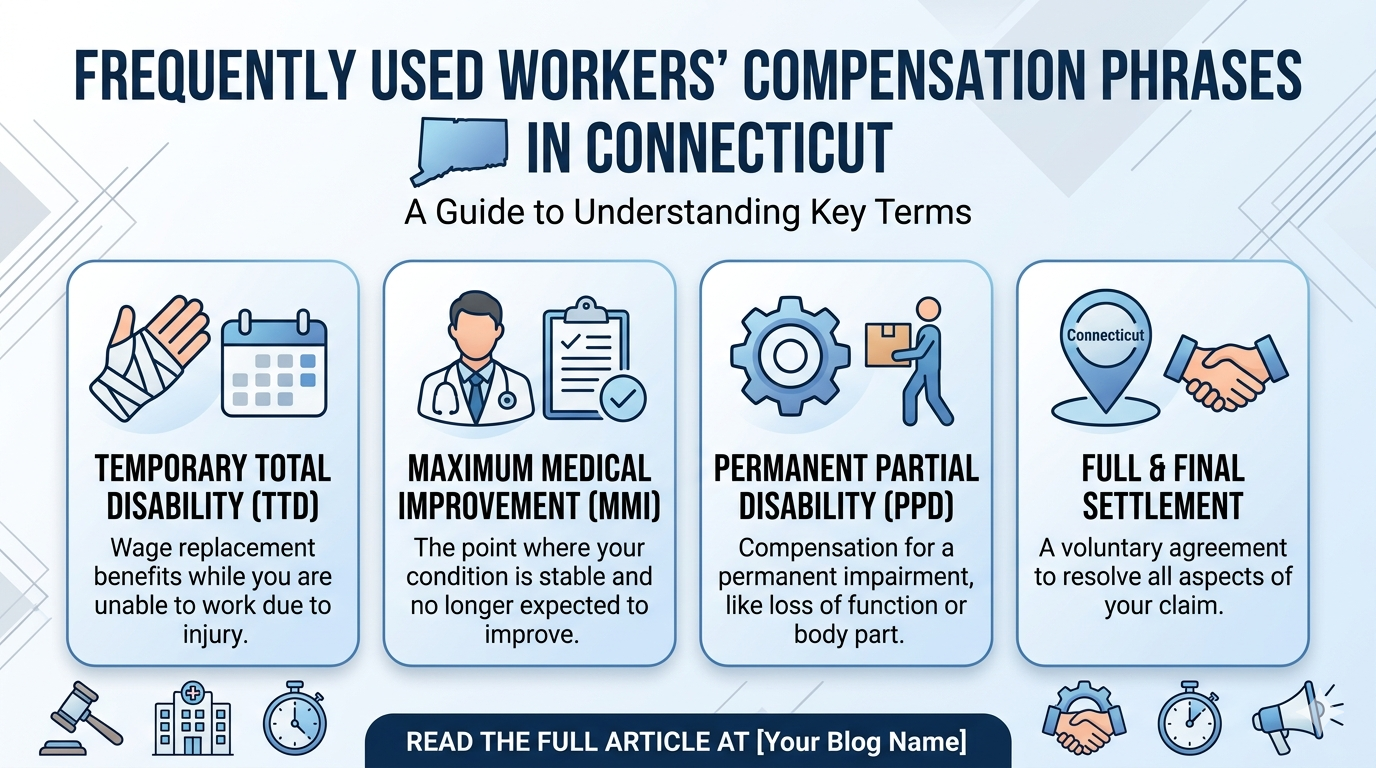
Navigating a Workers’ Compensation case can often feel like learning a new language. Legal jargon, medical acronyms, and specific form numbers can be overwhelming for an injured worker.

Below is an expanded, numbered guide to the most common phrases used by attorneys, insurance adjusters, and doctors in Workers’ Compensation proceedings.

  1. General Roles and People
  1. Claimant: The injured worker who is filing the claim for benefits.
  2. Respondent: The employer and/or their insurance company that is “responding” to the claim.
  3. Commissioner: The administrative judge who presides over Workers’ Compensation hearings and makes rulings on disputed issues.
  4. TPA (Third Party Administrator): An outside company hired by a self-insured employer to process and manage Workers’ Compensation claims.
  1. Disability and Work Capacity Status
  1. TT (Temporary Total Disability): A status assigned by a doctor when an injured person is completely incapable of performing any level of work. While “TT,” the worker typically receives weekly indemnity checks.
  2. TP (Temporary Partial Disability): Often called “Light Duty.” This means the worker is injured but capable of some level of work. To receive benefits while TP, a worker may need to perform a “job search” if the employer cannot accommodate their restrictions.
  3. PPD (Permanent Partial Disability): A permanent loss of function to a specific body part (e.g., a 10% loss of use of the back) assigned after the worker has finished active treatment.
  4. PTD (Permanent Total Disability): A status for workers whose injuries are so severe that they will never be able to return to any form of gainful employment.
  5. MMI (Maximum Medical Improvement): The point at which a doctor determines that a patient’s condition has stabilized and no further functional improvement is expected from additional medical treatment.
  1. Medical Examinations
  1. RME (Respondent’s Medical Examination): An evaluation performed by a doctor chosen and paid for by the insurance company to provide a second opinion on the case.
  2. IME (Independent Medical Examination): Often used interchangeably with RME, though truly “independent” exams are rare as they are usually requested by one side or the other.
  3. CME (Commissioner’s Medical Examination): A “tie-breaker” exam ordered by the Commissioner when the Claimant’s treating doctor and the Respondent’s RME doctor disagree on a key issue (like surgery or PPD rating).
  1. Benefits and Legal Awards
  1. 31-308a Benefits: Discretionary weekly benefits paid after PPD benefits are exhausted. These are intended to help workers who have a permanent impairment and are earning less than they did before the injury.
  2. Stipulation (Settlement): A full and final closing of a case for a lump sum of money. By “stipulating,” the worker usually gives up all future rights to medical care and weekly checks in exchange for the payment.
  3. VA (Voluntary Agreement): An official document (traditionally printed on green paper) that signifies the insurance company has formally accepted the injury or a specific PPD rating as compensable.
  4. COLA (Cost of Living Adjustment): Annual increases in the compensation rate for certain long-term total disability claims.
  1. Essential Forms
  1. Form 30C: The primary form used to initiate a Workers’ Compensation claim. It provides official notice of the injury to the employer and the Commission.
  2. Form 36: A notice issued by the insurance company stating its intent to stop or reduce weekly benefits (e.g., because a doctor says the worker can return to work).
  3. Form 42: A specific request sent to a physician to provide a permanent partial disability (PPD) rating.
  4. Form 1A: A “filing status” form used to determine the worker’s tax filing status and dependents, which affects the calculation of the weekly compensation rate.
  1. The Hearing Process
  1. Informal Hearing: A 15-to-20-minute meeting where lawyers and the Commissioner discuss disputed issues to try to reach a recommendation or settlement without a trial.
  2. Pre-Formal Hearing: A more structured meeting used to narrow down the evidence and witness lists in preparation for a trial.
  3. Formal Hearing: A full legal trial. Evidence is submitted, witnesses testify under oath, and the Commissioner eventually issues a written, binding “Finding and Award” or “Finding and Dismissal.”
  4. C.R.B. (Compensation Review Board): The appellate body that hears appeals from decisions made by Commissioners at Formal Hearings.
  1. Modern & Technical Terms
  1. Utilization Review (UR): A process where a third-party medical professional reviews a treating doctor’s requested treatment (like an MRI or Physical Therapy) to decide if it is “medically necessary.”
  2. AWW (Average Weekly Wage): The calculation of the worker’s gross earnings (usually over the 52 weeks prior to injury) is used to determine the weekly benefit amount.
  3. Comp Rate: The actual dollar amount a worker receives weekly, which is typically a percentage of their AWW (subject to state maximums and minimums).
https://www.doddlawfirmct.com/wp-content/uploads/2019/11/shutterstock_493275868.jpg 4912 7360 matt http://www.doddlawfirmct.com/wp-content/uploads/2022/06/logo.png matt2019-11-19 23:05:042026-04-07 08:02:12Frequently Used Workers’ Compensation Phrases in Connecticut

Eastern Equine Encephalitis

September 25, 2019/by matt

New England is currently experiencing a wave of mosquitoes that have tested positive for Eastern Equine Encephalitis (EEE).  EEE is a disease mosquitoes can pass to humans that causes swelling of the brain and may result in death.  Connecticut state health officials are currently advising residents to take precautions against exposure to mosquitoes by using insect repellent, wearing long sleeves and avoiding the outdoors from between one hour before sunset until dawn, when mosquitoes are most active.  Early symptoms may include high fever, neck stiffness, headache, fatigue, and nausea/vomiting.

https://portal.ct.gov/DPH/Infectious-Diseases/ID-Home/Eastern-Equine-Encephalitis-EEE–Fact-Sheet

https://www.cdc.gov/easternequineencephalitis/gen/pre.html

When an infectious disease is contracted on the job, it may be a compensable Workers’ Compensation injury.  This applies to mosquito-born illnesses, such as EEE, Zika Virus and West Nile Virus, and also to illnesses caused by ticks, such as Lyme Disease.

In Connecticut, a school has been found negligent after it failed to adequately warn and protect a student from an identified insect related illness.

https://www.doddlawfirmct.com/wp-content/uploads/2019/09/shutterstock_657528181.jpg 2937 4406 matt http://www.doddlawfirmct.com/wp-content/uploads/2022/06/logo.png matt2019-09-25 19:39:582019-09-25 19:44:58Eastern Equine Encephalitis

Ross T. Lessack, 09/09/1955 – 04/04/2019

May 2, 2019/by matt

With great sorrow, The Dodd Law Firm mourns the loss of partner, Ross T. Lessack.  Since joining the firm, Attorney Lessack worked as a dedicated advocate for his clients.  He will be dearly missed.

https://www.rep-am.com/obituaries/2019/04/06/ross-t-lessack/

https://www.doddlawfirmct.com/wp-content/uploads/2018/05/0005_dodd_law_firm_photoiris_R_Hi_Res_for_Printing-e1526071180534.jpg 431 287 matt http://www.doddlawfirmct.com/wp-content/uploads/2022/06/logo.png matt2019-05-02 18:39:482019-05-02 18:42:28Ross T. Lessack, 09/09/1955 – 04/04/2019

Click here for more information on this seminar

November 27, 2018/by matt

Attorney Jonathan H. Dodd of the Dodd Law Firm will give a presentation at the “Civil Trial:  Everything You Need to Know” seminar on December 7, 2018 at the Holiday Inn in East Hartford, CT.  The seminar is hosted by the National Business Institute.

Attorney Dodd will be speaking on the issues of expert witness questioning and effective strategies for discussing injuries at trial.

Click here for more information on this seminar.


https://www.doddlawfirmct.com/wp-content/uploads/2018/05/0002_dodd_law_firm_photoiris_R-Edit_Hi_Res_for_Printing-e1526070840378.jpg 431 287 matt http://www.doddlawfirmct.com/wp-content/uploads/2022/06/logo.png matt2018-11-27 18:58:542018-11-27 18:58:54Civil Trial Seminar

Repetitive Trauma and the Modern Worker: A Connecticut Guide to Workers’ Compensation in 2026

August 21, 2018/by matt

For many, the phrase “workplace injury” conjures images of sudden, dramatic accidents—a fall from a ladder, a construction site mishap, or a slip in a warehouse. While these acute injuries are common, they represent only one facet of the risks facing the modern workforce. In 2026, as our economy increasingly relies on high-speed automation, prolonged digital interface, and intensive manual logistics, a more subtle threat has taken center stage: Repetitive Trauma Injuries.

Workers’ Compensation benefits are not limited to those injured in single, identifiable accidents. Benefits are also available to employees who suffer from the cumulative impact of repetitive activities on the body over months or years. Known legally as “cumulative trauma” or “repetitive strain,” these conditions are often more complex to prove but just as debilitating as any sudden fracture.

The Evolution of Repetitive Trauma in 2026

As we move further into the mid-2020s, the definition of repetitive trauma has expanded. We no longer just look at the assembly line worker or the typist. Today’s repetitive trauma claims often involve:

  • Remote Work “Tech Neck” and Postural Strain: With a significant portion of the workforce still operating from home offices that often lack professional ergonomic oversight, we have seen a surge in cervical spine issues and upper-back degenerative conditions.
  • Logistics and Fulfillment Fatigue: The “delivery economy” has peaked. Workers in massive automated fulfillment centers are often required to perform high-frequency movements—reaching, pivoting, and scanning—thousands of times per shift, leading to rapid joint degradation.
  • Haptic Interface Strain: In specialized fields using VR/AR interfaces or haptic gloves (common in remote surgery, advanced manufacturing, and engineering), new forms of micro-repetitive strain in the fingers and wrists have emerged.

Common Types of Repetitive Trauma Injuries

While the list of potential injuries is vast, several conditions remain the “hallmarks” of cumulative trauma claims.

  1. Carpal Tunnel Syndrome and Nerve Compression

Perhaps the most famous repetitive injury, Carpal Tunnel Syndrome (CTS), involves the compression of the median nerve in the wrist. In 2026, this is not just an “office worker” disease; it is prevalent among dental hygienists, garment workers, and those in the tech sector who utilize gesture-based controls. Symptoms often begin as a faint tingling or numbness in the thumb and index finger, eventually progressing to a loss of grip strength that can end a career.

  1. Occupational Hearing Loss

Often overlooked because it happens gradually, hearing loss from loud work environments is a classic repetitive trauma. Despite advancements in “smart” noise-canceling PPE, workers in aviation, manufacturing, and even high-decibel entertainment venues remain at risk. In many jurisdictions, the “cumulative” nature of hearing loss requires sophisticated audiometric testing to prove the loss occurred during the period of employment.

  1. Rotator Cuff and Shoulder Impingement

Frequent overhead work—common for electricians, painters, and HVAC technicians—causes micro-tears in the tendons of the shoulder. Over time, these tears fail to heal, leading to chronic inflammation or full-thickness tears. By 2026, medical imaging (such as high-resolution dynamic ultrasound) will have made it easier to show how specific repetitive motions have “frayed” the tendon over time.

  1. Degenerative Disc Disease and Spinal Trauma

Frequent heavy lifting, twisting, and bending are the primary culprits for back injuries. Unlike a “herniated disc” caused by lifting one heavy box, degenerative back conditions involve the gradual wearing away of the cushioning between vertebrae. In the modern legal landscape, employers often try to blame these conditions on “aging” or “pre-existing wear and tear.” However, if work activities accelerated the condition, it is a compensable injury.

  1. Epicondylitis (Tennis/Golfer’s Elbow)

Inflammation of the tendons surrounding the elbow is common in jobs involving repetitive gripping or tool usage, such as plumbing, carpentry, and even intensive data entry.

The Legal Threshold: Proving the Link

The greatest challenge in a repetitive trauma claim is the “Causation Barrier.” Unlike a broken leg, where the cause is obvious, a repetitive injury requires medical evidence to link the condition directly to the job duties.

In 2026, courts and Workers’ Compensation boards typically look for “Gradual Onset” and “Specific Work Exposure.” To successfully bring a claim, the evidence must show that:

  1. The work required repetitive motions, vibrations, or pressures.
  2. The frequency and duration of these activities were sufficient to cause the injury.
  3. The injury is not solely the result of non-work-related activities or natural aging.

Modern litigation often involves “Ergonomic Experts” who analyze a worker’s daily routine, counting repetitions and measuring force, to provide a scientific basis for the claim.

Statutes of Limitations: The 2026 Landscape

Timing is everything. In many states and jurisdictions, the “clock” for filing a claim starts at different times for repetitive trauma than it does for an accident. As noted in the current legal framework:

  • The Last Date of Exposure: A worker must often file within one year of the last date they performed the repetitive work.
  • The Discovery Rule: Alternatively, a claim can often be filed within three years from the date the worker first experienced symptoms and knew (or should have known) that the symptoms were caused by their work.

Warning: Waiting until you can no longer work at all is a common mistake. By the time the pain is unbearable, you may have passed the statutory deadline. Early reporting is essential.

Challenges in the 2026 Claims Process

The landscape for Workers’ Comp has become more rigorous. Insurance carriers now utilize AI-driven “Claims Adjusters” to scan medical records for any mention of outside hobbies (like gardening, gaming, or sports) to argue that the injury occurred outside of work.

Furthermore, the rise of the “Gig Economy” has complicated these claims. If you are classified as an independent contractor rather than an employee, you may be initially denied benefits. However, “Misclassification Suits” are at an all-time high in 2026, and many “contractors” are successfully arguing they are legally employees entitled to repetitive trauma coverage.

Steps to Take if You Suspect an Injury

If you believe your chronic pain or loss of function is work-related, you should follow these steps immediately:

  1. Report the Symptoms to Your Employer: Even if you don’t have a “diagnosis” yet, notify your supervisor in writing that you are experiencing pain you believe is related to your repetitive tasks.
  2. Seek a Specialized Medical Opinion: General practitioners may miss the occupational link. See an occupational therapist or an orthopedic specialist who understands workplace ergonomics.
  3. Document Your Daily Routine: Keep a log of how many times a day you perform a specific action (e.g., “I lift 20lb bins approximately 400 times per shift”).
  4. Consult a Workers’ Compensation Attorney: Because repetitive trauma claims are frequently contested by insurance companies, having a legal expert to navigate the “medical-legal” interface is vital.

You Deserve Protection

The body is not a machine; it has limits. Whether you are a software engineer with debilitating wrist pain, a warehouse associate with a failing back, or a nurse with shoulder strain from patient transfers, the law recognizes your right to a healthy body.

Workers’ Compensation is a system designed to provide medical care and wage replacement while you recover. Do not let the gradual nature of your injury convince you that it is “not a real injury.” In 2026, the cumulative impact of work is more recognized than ever.

If you or a family member is suffering from a chronic injury caused by a period of repetitive work activity, please do not hesitate to contact a Workers’ Compensation attorney. Determining your eligibility early can mean the difference between a successful recovery and a lifetime of chronic pain.

https://www.doddlawfirmct.com/wp-content/uploads/2018/08/Repetitive-Trauma-and-the-Modern-Worker-A-Connecticut-Guide-to-Workers-Compensation-in-2026.png 768 1376 matt http://www.doddlawfirmct.com/wp-content/uploads/2022/06/logo.png matt2018-08-21 18:15:542026-04-07 07:48:55Repetitive Trauma and the Modern Worker: A Connecticut Guide to Workers’ Compensation in 2026

Understanding the Difference Between Workers’ Comp and Third-Party Claims in Connecticut (2026 Update)

November 10, 2017/by admin

Navigating the aftermath of a workplace injury is more complex today than ever before. With the rise of hybrid work models, automated job sites, and an increasingly interconnected gig economy, the lines between “on the clock” and “on your own” can sometimes blur. If you are injured while performing work duties in 2026, you generally have two primary paths to financial recovery: a workers’ compensation claim or a third-party personal injury claim.

While both aim to provide financial relief, they operate under entirely different legal frameworks. Understanding these differences is critical to ensuring you receive the full amount of compensation you are owed.

What is Workers’ Compensation?

Workers’ compensation is a form of “no-fault” insurance that almost every employer is required to carry. In 2026, this system remains the bedrock of American labor protection. The “no-fault” aspect is the most important feature: you do not have to prove that your boss or a coworker did something wrong to collect benefits. As long as the injury happened within the “scope of employment,” you are covered.

This system is often described as the “exclusive remedy” or the “grand bargain.” In exchange for guaranteed medical coverage and partial wage replacement, employees give up their right to sue their employer for pain and suffering or full negligence. Even if your employer was arguably careless—such as failing to fix a loose floorboard—you generally cannot sue them in civil court; you must go through the workers’ comp system.

The Scope of Workers’ Comp in 2026

As of 2026, the definition of the “workplace” has expanded. For the millions of Americans working in hybrid or fully remote roles, workers’ comp now frequently covers injuries sustained in home offices, provided the injury occurred during set working hours while performing a task for the benefit of the employer.

The trade-off for this broad coverage is that the benefits are capped. Typically, workers’ comp covers:

  1. Medical Expenses: 100% of “reasonable and necessary” medical treatment related to the injury.
  2. Wage Replacement: Usually around two-thirds to 75% of your average weekly wage, often subject to a state-mandated maximum cap.
  3. Vocational Rehabilitation: Training for a new role if you can no longer perform your previous job.
  4. Permanent Disability: Fixed payments if the injury results in a lasting physical limitation.

What is a Third-Party Claim?

A third-party claim is a traditional personal injury lawsuit filed against an individual or entity that is not your employer or a direct coworker. Unlike workers’ comp, this is a “fault-based” system. To win, you must prove that the third party was negligent and that their negligence directly caused your injuries.

In 2026, third-party claims are increasingly common due to the “multi-employer” nature of modern job sites. Whether it is a delivery driver at a warehouse, a software consultant at an office, or a subcontractor on a construction site, many people you encounter during your workday do not actually work for your company.

Why Pursue a Third-Party Claim?

If workers’ comp covers medical bills, why bother with a third-party claim? The answer lies in the types of damages available. Personal injury lawsuits allow you to recover “non-economic” damages that workers’ comp ignores completely. These include:

  • Pain and Suffering: Compensation for the physical and emotional distress caused by the accident.
  • Full Wage Loss: Unlike workers’ comp, which caps your pay at a percentage, a third-party claim allows you to seek 100% of your lost income and future lost earning capacity.
  • Loss of Enjoyment of Life: Compensation for the inability to engage in hobbies or family activities.
  • Punitive Damages: In rare cases of extreme or “gross” negligence, a jury may award extra money to punish the wrongdoer.

Common Third-Party Scenarios in 2026

To identify a third-party claim, you must look at who was involved in the chain of events leading to your injury.

  1. Motor Vehicle Accidents

This is the most frequent type of third-party claim. If you are a delivery driver or an employee traveling between work sites and a distracted driver hits you, you have a workers’ comp claim (because you were working) AND a third-party claim against the other driver’s insurance.

  1. Contractors and Subcontractors

On construction sites or in large corporate facilities, workers from multiple different companies often share the same space. If a specialized HVAC contractor leaves a dangerous hazard that causes you to fall, they are a “third party,” and you can sue their company for full damages.

  1. Product Liability

With the increased use of automation and robotics in 2026, equipment failure is a significant source of injury. If a defective battery in a tool explodes or a warehouse robot malfunctions due to a software glitch or mechanical defect, the manufacturer of that product can be held liable.

  1. Property Owners (Premises Liability)

If your job requires you to visit clients or work at a site not owned by your employer, the owner of that property has a duty to keep it safe. If you slip on an unmarked wet floor at a client’s retail space, the property owner is a third party.

The Relationship Between the Two Claims

It is important to know that you can often pursue both claims simultaneously. However, you cannot “double dip” on the same expenses. This is handled through a process called “subrogation.”

If workers’ comp pays $20,000 for your surgery, and you later win a $100,000 settlement from a third party, the workers’ comp insurance company usually has a legal right to be reimbursed for the $20,000 they spent. Even after this reimbursement, however, the injured worker usually ends up with significantly more money because of the “pain and suffering” and “full wage” components of the third-party settlement.

The Role of Negligence: Coworker vs. Third Party

One of the most frustrating aspects for injured workers is the “coworker rule.” If your direct coworker—someone employed by the same company as you—causes your injury through negligence, you are barred from suing them.

For example, if a coworker accidentally knocks over a heavy shelf that crushes your arm, your only recourse is workers’ comp. However, if an outside vendor delivering office supplies knocks over that same shelf, they are a third party, and a lawsuit is possible. The identity of the person who made the mistake is the “make or break” factor for your legal options.

Proving Fault in 2026

Proving negligence in a third-party claim requires more evidence than a workers’ comp filing. In 2026, this often involves digital evidence. An attorney might look at:

  • Telematics and GPS Data: To prove a driver was speeding or distracted.
  • Surveillance Footage: High-definition security cameras are now ubiquitous in most workplaces.
  • Maintenance Logs: Digital records showing that a third-party contractor skipped a required safety inspection.
  • AI Diagnostics: In cases involving machinery, data logs from the equipment can prove that a manufacturing defect existed before the accident.

Where Should You Start?

You should generally start with workers’ compensation. The waiting period is much shorter and doesn’t require that you prove negligence, so you can start getting treatment and partial income replacement right away. You can then start the process of a personal injury claim, which may give you the chance to recover more compensation.

Keep in mind that any benefits you receive from workers’ compensation will need to be repaid if your third-party claim is successful. That money is generally repaid from your settlement or court award before you get your portion.

Using an Attorney is the Best Way to Protect Yourself

A workplace injury can leave you stressed and overwhelmed, but you should still move quickly to explore your options. You generally only have a limited time frame to file a personal injury claim, and evidence has a short shelf life. If you don’t gather evidence right away after an injury, you’ll likely lose it forever. If you consult a workers’ compensation attorney, they will be able to look at the details of your case and figure out whether or not a third-party claim is an option for you.

Contact The Dodd Law Firm to Explore Your Legal Options

We’re here to help you as you begin the process of recovering from a workplace injury. Set up a time to talk to our team now by reaching out online or calling us at 203-272-1883. Whether you have a straightforward workers’ compensation claim or a third-party claim, we will be by your side the entire time.

https://www.doddlawfirmct.com/wp-content/uploads/2017/11/shutterstock_2039879759-1.jpg 667 1000 admin http://www.doddlawfirmct.com/wp-content/uploads/2022/06/logo.png admin2017-11-10 13:49:192026-04-07 07:22:03Understanding the Difference Between Workers’ Comp and Third-Party Claims in Connecticut (2026 Update)
Page 3 of 41234

Our Latest Posts

  • Who Is at Fault in a T-Bone Accident at a Connecticut Intersection?
  • What Happens If a Driver Passes a Stopped School Bus in Connecticut?
  • Proving Driver Blind Spot Negligence in Side-Swipe Motorcycle Accidents
  • Overweight Trucks: Enforcement Failures and Their Impact on Accident Liability
  • What Happens If I Can’t Work During My Personal Injury Case?
  • The Legal Implications of ELD (Electronic Logging Device) Manipulation in Connecticut Truck Accident Cases
  • Can I Sue If I Was Injured as a Passenger in Someone Else’s Car? 
  • How Do I Pay My Medical Bills While Waiting for My Case to Settle in Connecticut?
  • Should I Give a Statement to the Other Driver’s Insurance Company after a Car Crash?
  • How Long Will My Connecticut Personal Injury Case Actually Take to Settle?

schedule your free consultation
HABLAMOS ESPAÑOL / SI PARLA ITALIANO

Ten Corporate Center
1781 Highland Avenue, Suite 105
Cheshire, CT 06410

DIRECTIONS

OFFICE
(203) 272-1883

FAX
(203) 272-2077

EMAIL
contact us

IN THE NEWS

  • Who Is at Fault in a T-Bone Accident at a Connecticut Intersection?
    Who Is at Fault in a T-Bone Accident at a Connecticut Intersection?August 18, 2026 - 6:20 am

    The screech of tires at a busy intersection in New Haven or Stamford lasts only a second, but the aftermath of a T-bone collision alters lives indefinitely. Side-impact crashes, commonly known as broadside accidents, occur when the front of one vehicle strikes the side of another, forming the shape of the letter T. Because passenger […]

© 2026 The Dodd Law Firm, LLC. All Rights Reserved. SITE MAP | DISCLAIMER
  • SITE BY
  • TOO DARN LOUD – DIGITAL MARKETING
Scroll to top Scroll to top Scroll to top